
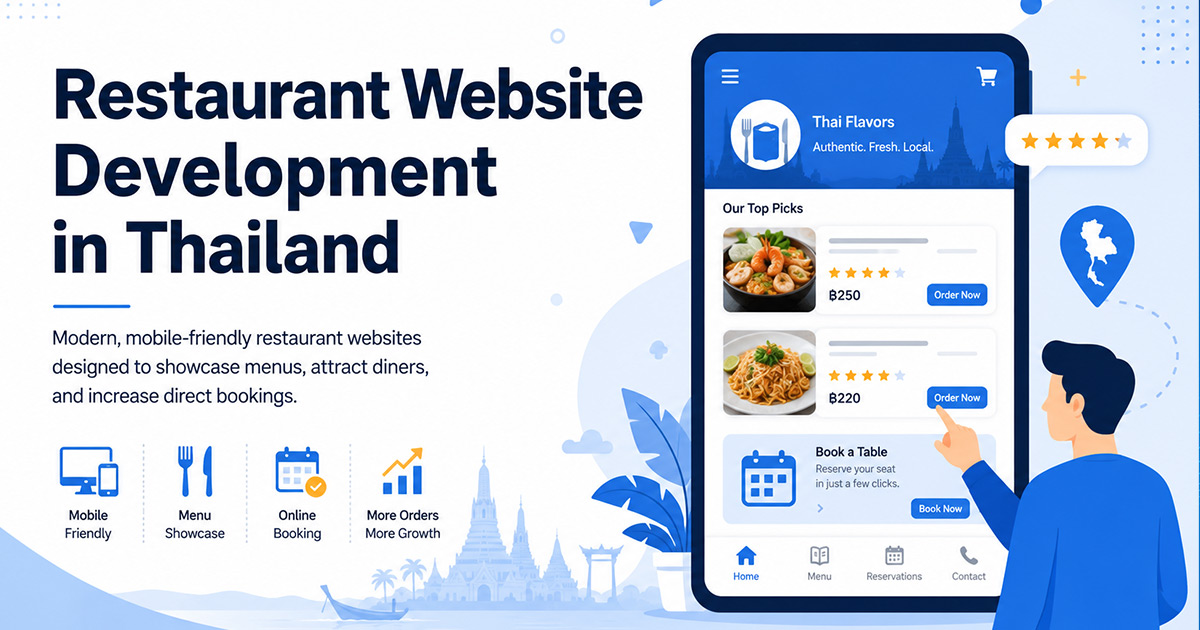
Saturday, 7:40pm. Two seats have just become a no-show. The host is trying to fill them from three different places: a LINE chat that started at lunch, a WhatsApp message from a guest and a voicemail sitting on the reservation phone. None of those are a booking. They’re messages. Until somebody checks the phone, replies, confirms the time, checks the table plan and tells the floor, those two seats are still empty.
By the time the conversation is finished, first courses are already going out. The table stays empty. That’s the actual job of a restaurant website. Not a slow-motion video of the dining room. Not a full-screen photograph of a cocktail. Not another button sending somebody to Instagram.
A customer should be able to land on the website, understand what you serve, see whether you have a table, understand the booking conditions and hold those seats without waiting for whoever has the reservation phone to look up from service. Most restaurant websites in Bangkok fail that test within ten seconds. There is a PDF menu, an Instagram link and a button that says “Contact Us.” Meanwhile, Grab has the current dishes, photographs, prices, availability and a button that actually does something. Grab also takes a cut of the cheque.
Sierra IT Group builds your restaurant website and your restaurant POS as parts of the same operation, rather than treating them as two unrelated projects handled by two different vendors. One list of tables. One list of dishes. One set of prices. One view of what is available. What the floor sees, what the kitchen sees and what the guest sees on the website should all tell the same story.
Restaurant reservation systems in Bangkok
LINE and WhatsApp are how Bangkok talks, but they’re terrible as the only reservation system.
The regular who always asks for the garden table should absolutely still be able to message the house. The guest who knows the manager can still send a LINE. The concierge can still call but the person discovering the restaurant for the first time should not need your phone number, wait for a reply or wonder whether a blue tick means the reservation has actually been accepted.
A proper restaurant reservation system should show the date, available times and number of covers. It should explain tasting-menu requirements, deposits, cancellation rules, minimum spends or no-show holds before the guest reaches the final step. Once the reservation is made, it should go somewhere useful.
It should write into the restaurant’s actual reservation list or floor plan, reduce the available inventory and give the team one clear record of who is arriving and when. The guest receives a confirmation immediately instead of waiting for a member of staff to type one between tables. That difference matters most during service. A reservation request sitting unanswered in LINE is still only a request. Chat fills the inbox. A reservation system fills the restaurant.
It also gives you something the messaging apps cannot: structure. Guest name, telephone number, email, covers, time, table preference, dietary notes, special occasions, deposits and booking history can all live in the same record instead of being scattered between personal phones.
Gaa by Chef Garima Arora on Sukhumvit 53 is a restaurant website we’ve already shipped. For a restaurant operating at that level, the website cannot just function as a digital brochure. It needs to communicate the restaurant properly, support discovery and make the path from search to reservation as clear as possible. The site was built specifically around the restaurant, with SEO considerations and structured data incorporated into the website rather than added as an afterthought.
Digital restaurant menus, not PDFs
A photographed menu is not a digital menu. Neither is a 14MB PDF uploaded six months ago.
A guest sitting in a taxi should be able to check what you’re serving without downloading a document, pinching the screen and wondering whether the menu is still current. Search engines should be able to understand the dishes, ingredients and concepts on the page. Your staff should be able to change a price without waiting for a designer to export another PDF.
Restaurant menus should be built as actual web content: dish names, descriptions, prices, categories and real photographs where appropriate. That makes the menu easier to use and considerably more useful for search. Terms such as “omakase Thonglor,” “tasting menu Sukhumvit,” “Sunday brunch Bangkok” or “private dining Bangkok” are connected to actual information people are looking for. If the important details exist only inside a scan or image, you’re making that information harder for both guests and search engines to understand.
There is an operational reason as well. If the blue crab disappears from tonight’s menu, the website should not continue selling the idea that it is available for another three weeks. If lunch changes on Monday, the digital menu should change on Monday. If the price changes, the website should not require somebody to open Illustrator. When the plate and the page disagree, guests usually trust the platform that appears to have the newest information. Too often, that is Grab rather than the restaurant itself. Your own website should be the most accurate source of information about your own restaurant.
Direct restaurant ordering and pre-orders
The same rule applies to takeaway and everything around the main dining room.
Lunch pre-orders, bakery boxes, afternoon tea, wine packages, gift seats, event menus and restaurant merchandise can all make sense as direct website sales.
But adding a shopping cart is the easy part. The difficult part is what happens after the guest presses the button. If a direct order arrives by email and somebody has to notice it, print it, walk into the kitchen and explain it, the website hasn’t automated much. You’ve simply created another inbox. A direct restaurant ordering system only becomes operationally useful when the order enters the same workflow the restaurant already uses. The kitchen sees it. The item availability is correct. The collection time is clear. Payment status is visible. The ticket reaches the right station.
Otherwise the restaurant saves the delivery-platform commission and replaces it with administrative chaos.
Restaurant POS in Thailand
The website is not the till, and it should not pretend to be. When separate systems start inventing their own version of restaurant reality, problems appear quickly. A table gets seated twice. A guest orders something that was already 86’d. A takeaway order never reaches the kitchen. Somebody closes the night by comparing three different spreadsheets.
A cloud restaurant POS belongs on the operational side of the restaurant.
Tableside ordering, open tables, split bills, open tabs, kitchen tickets, modifiers, discounts, payment records and end-of-day reporting all need to work together. The system also needs to survive the practical realities of Bangkok restaurants, including unreliable connections. Losing Wi-Fi for a few minutes should not mean losing the ability to operate the floor.
For many restaurants, a good standard POS configuration is enough. A custom restaurant POS becomes useful when the service itself doesn’t fit neatly inside the assumptions of a generic register. A tasting menu may need pacing by course rather than by item. A wine programme may need a cellar structure that has nothing in common with food inventory. A hotel restaurant may have four outlets, several price lists and different menus depending on the room, time or guest type.
At that point, forcing the restaurant to behave like the software is backwards. The software should describe how the restaurant actually works.
Connecting the restaurant website and POS
This is where building the website and operational system together starts to matter.
The public website does not need access to every function inside the POS, but the two systems should understand the same underlying information. If a dish becomes unavailable, the restaurant should have a sensible way to stop selling or promoting it online. If a reservation consumes the final table at 8:30pm, another guest should not be allowed to book the same inventory five minutes later. If a pre-order has already been paid for, the kitchen should not have to ask the guest for payment again.
This does not mean connecting absolutely everything to everything else. Restaurants still need sensible boundaries between the public website, booking system, payment system and POS. It means avoiding five disconnected databases that staff have to reconcile manually every night.
Japanese restaurant POS
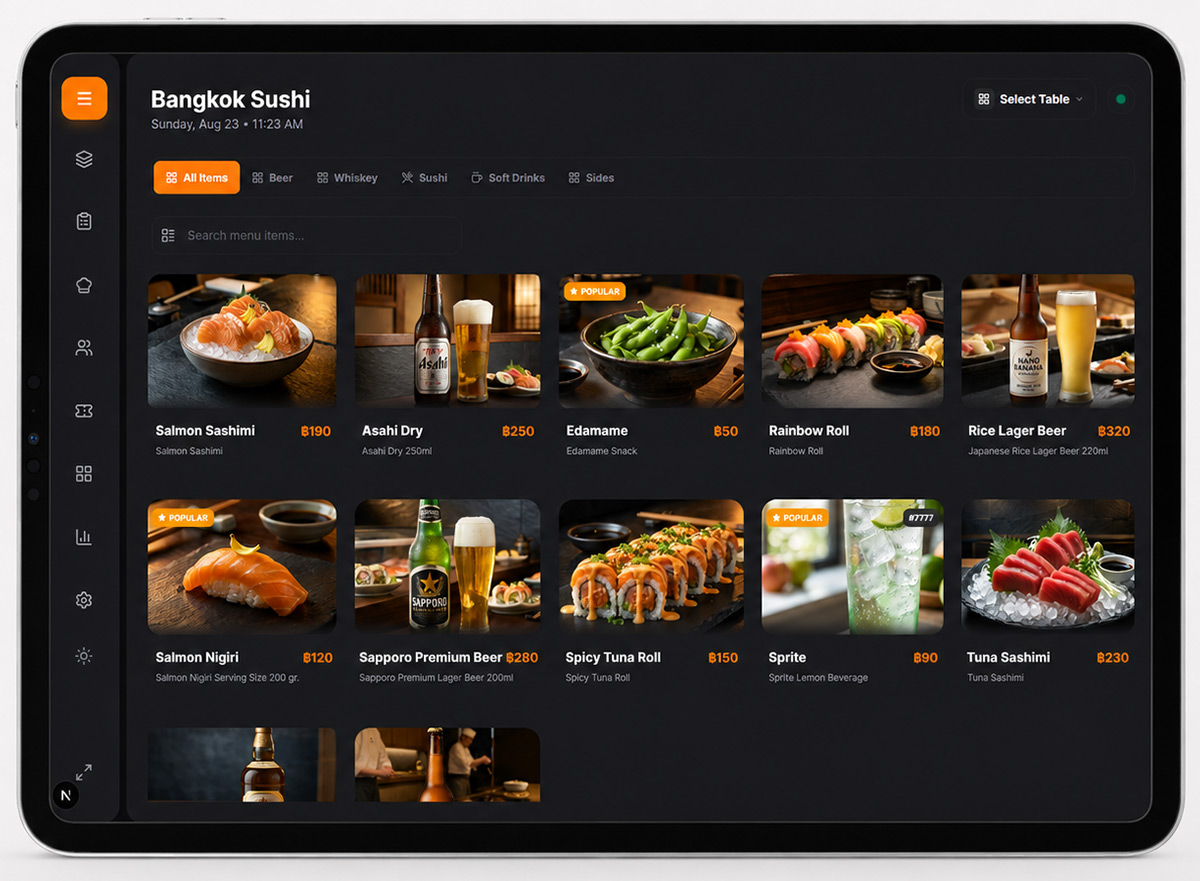
Japanese restaurants are a good example of where a generic till can start to fall apart. Counter seats are not the same as tables. Premium fish can disappear during service. Omakase courses have timing. Sake and wine may require their own inventory logic. One party may need to be split six ways at the end of the meal even though every guest effectively shared the same service.
Those workflows cannot always be represented properly as “item 17 plus two extras.”
That is what a dedicated Japanese restaurant POS is intended to handle.
Tableside ordering can go directly to the kitchen display. Premium products can be tracked against live inventory. Counter service and dining-room service can be handled differently where necessary. Courses can be managed as courses rather than as unrelated products appearing randomly on a ticket. It also means the restaurant is not locked into proprietary hardware simply because the software vendor decided the tablet on the counter needs to cost five times what an ordinary commercial device costs.
Bangkok has plenty of articles comparing the “best POS in Thailand.” Most compare feature checklists: barcode support, staff accounts, reports and payment integrations. Those features matter, but they do not answer the more useful question: does the system understand how this particular restaurant serves a guest? For sushi, izakaya and omakase operations, that question is considerably more important.
Restaurant SEO in Bangkok, 2026
Reservations only matter if people can find the restaurant in the first place. Restaurant SEO is not about publishing twenty generic blog posts explaining what sushi is. It starts with making the restaurant itself understandable. The website should clearly identify what you serve, where you are, when you’re open, how reservations work and what makes the restaurant relevant to a particular search.
Restaurant schema helps search engines understand that information. Your Google Business Profile should agree with the website on the restaurant name, location, opening hours, telephone number and other important details. Menus should contain readable content. Individual concepts such as private dining, tasting menus, brunch or omakase should have enough information to deserve being found.
That is how searches such as “fine dining Sukhumvit 53,” “Japanese restaurant Thonglor,” “omakase near me” or “private dining Bangkok” have a realistic chance of turning into an actual person walking through the door. The goal is not traffic for the sake of reporting a bigger number in Analytics. A restaurant does not need 50,000 visitors researching something unrelated to dinner. It needs the right guest to find the right page and make a reservation.
Your restaurant should own the guest relationship
There is another reason to make the restaurant website useful: ownership. Instagram can change its reach. Delivery platforms can change commissions. Booking platforms can change fees. Messaging apps can suspend accounts or simply become impossible to manage once enough staff members are involved. Your website is the one place where the restaurant controls the experience.
The reservation should come through your system. The menu should live on your domain. Direct orders should create usable customer records. Confirmation emails should come from the restaurant.
Even the email address matters more than people think. reservation@yourdomain.com looks like an established restaurant. A random Gmail address on the booking confirmation looks like a pop-up. If email is the missing piece, we’ll put mail on the restaurant’s domain as part of the wider setup.
What a good restaurant website actually needs to do
A restaurant website does not need to be complicated. It needs to be useful. The guest should be able to understand the restaurant immediately, view an up-to-date menu, see where the venue is, check opening times and make a reservation without starting a conversation. The restaurant should be able to update dishes and prices without rebuilding the site. Reservations should reach the floor in a usable format. Direct orders should reach the kitchen. The website should work properly on the phone somebody is holding in the back of a Grab at 6:15pm.
And when somebody searches for exactly the type of restaurant you operate, Google should have enough clear information to understand why your page belongs in the results. That is the difference between a restaurant website that looks good in a presentation and one that actually does a job every night. At 7:40pm on Saturday, the important question is not whether the homepage has a cinematic video.