
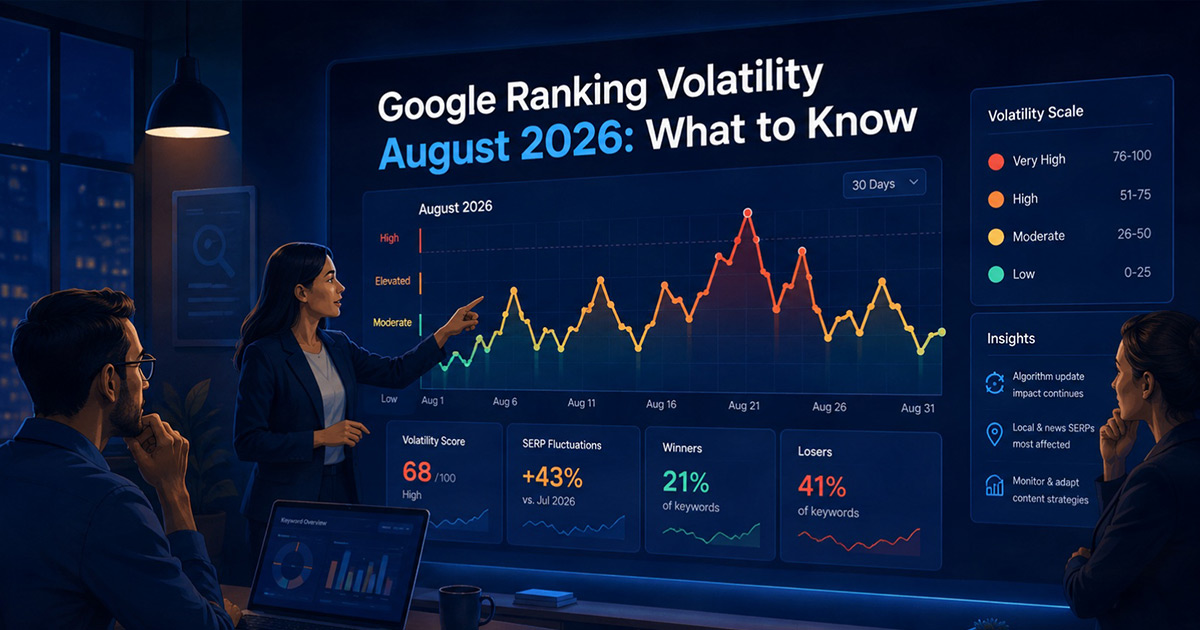
If your Google traffic has looked strange over the past few weeks, up one day, cut in half the next, you’re not imagining it and you’re not alone. Since the end of July the SEO community has been tracking wave after wave of ranking volatility that Google has not confirmed as an update and the pattern has only gotten messier as August has gone on. This is less a single event to react to and more a stretch of genuine uncertainty, and it’s worth understanding clearly rather than panicking over.
What’s actually been happening
The volatility has come in waves rather than one clean spike. 3rd party tracking tools first picked up unusual movement around July 18-19, then again on July 24, then a sharper spike from August 1 through 3, and then, just when things looked like they were settling, chatter across the SEO community heated up again into August 5 and 6, with site owners reporting big swings and reversals from whatever had happened earlier in the week. Google has not confirmed any of it. The last confirmed ranking update remains the June 2026 spam update, which wrapped up on June 26 and Google’s own Search Status Dashboard has shown no ranking, indexing, crawling or serving incident logged for any of these August dates.
That gap, real movement in the tools, silence from Google, is exactly what makes this stretch hard to plan around.
Why nobody, including Google seems to agree on what’s going on
What makes this round different from a typical core update is how inconsistent the reports have been. One site owner said their keyword positions actually improved while traffic dropped 14%. Another reported roughly half their traffic gone with no visible change in rankings at all. Some saw Google Discover traffic collapse, others saw indexing slow down, and at least one operator watched a site lose 70% of its traffic in an afternoon only to have it fully recover by the next morning. On top of that, Google confirmed a separate Google Ad Manager disruption on August 4th lasting roughly ten hours, and plenty of site owners separately reported GA4 real-time reporting acting up the same day, neither of which has anything to do with organic rankings but both of which got tangled into the same conversation.
The mood among SEOs discussing this on Reddit and elsewhere has shifted from the usual “is this an update” chatter into something closer to fatigue, several longtime practitioners have openly questioned whether chasing day-to-day ranking swings is still a useful way to do this job, given how much of what used to be a click now gets absorbed by an AI Overview before the searcher ever reaches a website. That question doesn’t have a clean answer yet, but it’s a fair one.
Ranking volatility isn’t the same as losing traffic
This is the part worth sitting with before making any changes to a site. A ranking tracker can show total chaos in the top ten results for a keyword while your actual clicks barely move, and the reverse is just as true, your position can hold steady while an AI Overview or a new SERP feature quietly absorbs the click that used to come to you. Confusing the two leads to the wrong fix: rewriting a page that was never actually losing traffic, or leaving alone a page that’s bleeding clicks because its rankings look fine on paper.
The only way to tell which one you’re dealing with is to look at impressions and clicks separately in Search Console, not just position.
What this means for Thai businesses
None of this changes what makes a site rank well over time, but it does change how you should read a bad week right now. A Bangkok hotel or ecommerce brand watching a traffic dip in mid-August has to ask a slightly different question than usual: is this a real ranking loss, is it an AI Overview eating the click, is it a measurement issue, or is it something on the site itself that shipped around the same time and is getting blamed on Google instead. All four look identical from the outside if you’re only glancing at a dashboard.
What to actually do about it
- Compare impressions against clicks in Search Console before touching anything. Falling impressions with roughly stable clicks points to something different than falling clicks with stable impressions.
- Segment by query, page, device and country rather than looking at sitewide totals. A dip in one query cluster can hide inside an otherwise flat week.
- Check whether AI Overviews are showing up for your key queries now when they weren’t before. A steady position with declining clicks is often that, not a ranking loss.
- Rule out your own recent site changes first. A template tweak, a plugin update, or a migration that shipped around the same time is an easier explanation than an unconfirmed algorithm shift.
- Give it one to two weeks before rewriting anything. Several of the swings reported this month reversed within days on their own.
Patience is doing more work than any quick fix right now. Rewriting a page that would have recovered on its own wastes effort and can introduce a new problem where there wasn’t one before.
How we handle this for our Clients in Thailand
At Sierra IT Group, this is exactly the kind of noise we filter out for our clients across Bangkok & Thailand before it turns into a panicked rewrite. We monitor Search Console data properly segmented, rule out technical and hosting causes first, since a slow site or a broken update can look identical to an algorithm hit, and only recommend content or SEO changes once we’re confident about what’s actually driving a dip. If your traffic has looked strange this month and you want a second opinion before changing anything, get in touch and we’ll help you read the data properly.