
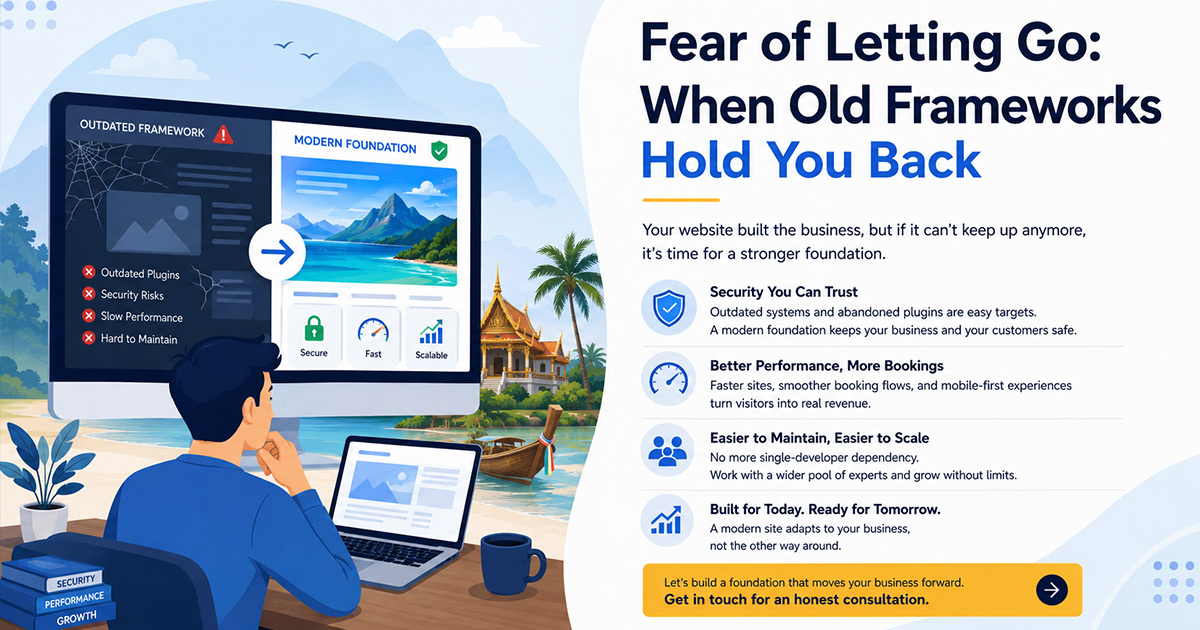
Every business eventually reaches a point where the system it was built on stops being an asset and quietly becomes a liability. Almost nobody rebuilds a website because they want to. They rebuild because the old one has started costing them more than it’s worth, in security risk, in speed, in missed bookings, in developer hours spent patching rather than improving. And yet, even once the case for change is obvious, plenty of businesses still don’t make the move. Not because they disagree with the logic, but because letting go of something familiar is harder than the logic accounts for.
We see this often enough that it deserves its own name, fear of letting go, and it’s rarely about the technology itself. It’s about the comfort of something known, even when what’s known is quietly working against the business.
A recent example makes the pattern clear: We’ve been actively maintaining a client’s website for nearly a year with great results, a rental operator with a genuinely beautiful portfolio of properties and a booking volume that should be growing faster than it is. The main issue (in our point of view) is that the site runs on Joomla (a framework we know very well, we’ve even worked with it since its first release under the name Mambo). This expertise is why we can say with confidence that Joomla was never the right foundation for what this business is trying to do. Before we took over, the site had already been built and extended for fifteen years by one developer, a hobbyist, working part-time. Our websites maintenance services since then has kept it fast, secure and running better than it ever has, but that’s the nature of good maintenance: it’s constant fixing, patching and fine-tuning of what’s already there, not a reason to avoid rebuilding the foundation when the foundation itself is the problem.
Fifteen years is a long time in web development. It’s long enough that the framework choices that made sense back then don’t anymore, long enough that the plugin ecosystem has thinned out, long enough that finding developers who still know Joomla well is genuinely difficult. We’ve told this client, clearly and more than once, that a rebuild onto a modern framework e.g. WordPress for content flexibility, or a custom Frontend or Next.js build for performance and control, would solve most of what’s currently holding the site back. They agree with the diagnosis but they still haven’t pulled the trigger, and probably never will.
What “fear of letting go” actually looks like
It rarely shows up as an argument against a rebuild. Almost nobody says “no, we want to keep the old system.” What we hear instead sounds more like hesitation dressed up as caution:
- “Our developer knows it best.” True, and also the entire problem, if that one person becomes unavailable, sick, retired, simply busy, there’s no one else who can step in.
- “It still works, mostly.” Mostly is doing a lot of work in that sentence. Slow admin panels, outdated plugins, and security patches that stopped coming years ago don’t announce themselves until something breaks badly.
- “We don’t want to lose what we have.” A rebuild doesn’t mean starting from zero, and it never should. Content, structure, SEO equity and design language can all move across. What changes is the foundation underneath it, not the business built on top.
- “It’s expensive and disruptive to switch.” Often true in the short term. Rarely true compared to the accumulating cost of staying on an unsupported system for another five years.
Every one of these is a reasonable feeling. None of them is a reasonable long-term strategy.
Why an outdated framework is a business risk, not just a technical one
A fifteen-year-old, hobbyist-maintained Joomla install isn’t just old, it’s a specific set of risks stacking up quietly in the background:
- Security exposure. Older CMS versions and abandoned plugin ecosystems are exactly where attackers look first, because the patches simply stopped coming.
- Single point of failure. One developer holding fifteen years of undocumented decisions in their head is not a maintenance plan, it’s a liability with a name attached.
- Slower everything. Booking flows, page speed, mobile responsiveness, all of it tends to lag behind on legacy frameworks that were never built with today’s traffic patterns or devices in mind.
- Missed revenue. For a business built on direct bookings, like villa rentals, hotels or tour operators, an outdated booking flow doesn’t just look dated, it actively loses reservations to competitors with faster, cleaner checkouts.
None of this is really about Joomla specifically. The same pattern applies to any framework that’s been left to age quietly for over a decade, WordPress, custom PHP, whatever it happens to be. The framework isn’t the issue by itself. The fifteen years without a serious architectural review is.
Why we push clients toward the harder conversation
We could quietly keep patching a fifteen-year-old system indefinitely. It would be easier for us, and it would generate ongoing maintenance work without ever having the uncomfortable conversation. We don’t do that, because it isn’t actually in the client’s interest and long-term, it isn’t in ours either. A rebuild onto a modern framework isn’t about chasing trends. It’s about giving a business software that can actually be maintained, secured and extended by more than one person, on a foundation that will still make sense in another five years, not just the next six months.
Whether that means moving to WordPress for a content-heavy site that needs flexibility, or a custom Next.js build for something that needs real performance and scale, the right answer depends on what the business actually does, not on what’s comfortable to keep.
Letting go is easier than it feels
Every rebuild we’ve done starts the same way, with a client who’s nervous about losing something. And every one of them, once it’s done, wonders why they waited so long. A proper migration keeps what matters, your content, your SEO rankings, your brand, and replaces only what needed replacing. It’s not starting over. It’s finally giving the business a foundation that matches how far it’s actually grown.
If you’re running a website that’s older than some of your staff, held together by one person’s institutional memory, and you already suspect it needs a rebuild but haven’t taken the step, that hesitation is normal. It’s also, almost always, more expensive to sit with than to act on. Get in touch and we’ll give you an honest read on what you actually have, what’s worth keeping, and what a proper modern foundation would look like for your business.