
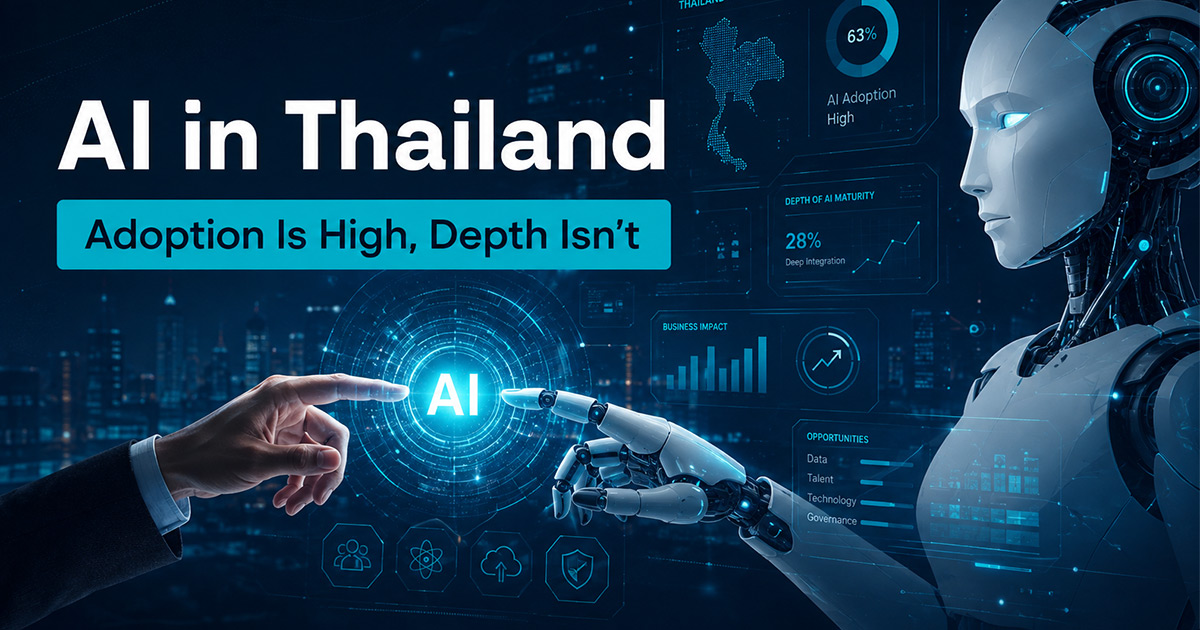
Thai businesses have adopted AI faster than almost anywhere else in the world. According to AWS’s Unlocking Thailand’s AI Potential 2026 report, 43% of Thai businesses now use AI consistently, up from 32% a year earlier, a jump equivalent to roughly 220,000 additional businesses in twelve months. Microsoft’s own Global AI Diffusion Report ranks Thailand second globally for AI adoption growth, behind only South Korea. On paper, that’s a genuine success story. The problem is what’s hiding underneath those numbers.
Thailand’s AI adoption numbers, in plain terms
The headline growth is real. Among Thai businesses using AI, 84% report productivity gains and 71% report increased revenue, averaging 19% growth, according to the same AWS report. UOB’s Business Outlook Study 2026 found more than seven in ten Thai SMEs are actively implementing AI, above the regional ASEAN average, with 58% of adopters reporting cost reductions and 44% reporting productivity gains. Separately, the Thailand Digital Outlook 2026 survey found the country’s overall digital maturity score rose to 2.12 out of 4, up from 1.56 the year before, its first time reaching what the Digital Economy and Society Office classifies as a medium maturity level.
Where most Thai businesses get stuck
Here’s the part that gets left out of most of the celebratory headlines. Of the businesses using AI, 74% are still sitting at what AWS classifies as the “basic” stage, largely off-the-shelf chatbots and ready-made tools used for routine tasks. Only 17% have reached “intermediate” use, meaning AI actually integrated across multiple business functions. Just 9% have reached “advanced,” running custom systems or automation with real autonomy, and that figure hasn’t moved in a year.
This isn’t a uniquely Thai problem. Global research from firms like McKinsey and PwC has found the same pattern almost everywhere: most AI initiatives never move past the pilot stage, usually because the fundamentals get skipped, clean data, a clear goal, someone managing the change, not because the AI itself doesn’t work. Thai businesses aren’t lacking access to AI. They have a ChatGPT subscription, maybe a chatbot plugin on the website, and that’s where it stops. What’s missing is the integration work that turns “we use AI” into “AI actually runs part of our business.”
What real AI automation actually looks like
The gap between basic and advanced usage isn’t really about which AI model you use, it’s about whether the AI is connected to the systems your business already runs on. A chatbot answering FAQs on your website is basic. A chatbot that reads your live inventory, checks a customer’s order history in your CRM, and escalates only the cases that actually need a human, that’s automation doing real work.
For most Thai businesses, the highest-value starting points are the unglamorous ones: automating the back-and-forth of customer inquiries across LINE, WhatsApp and web chat so staff aren’t retyping the same answers all day, digitizing manual approval chains like HR onboarding or expense sign-off, connecting your website, CRM and accounting software so data entered once doesn’t need to be re-entered three times, and using AI to summarize, screen or route incoming documents, resumes, invoices, supplier quotes, instead of a person doing it by hand.
Why the “basic” trap is so easy to fall into
None of this is really about Thai businesses lagging behind. Ipsos found that 80% of employed Thais already say AI tools have saved them time at work, well above the 62% global average, and Microsoft’s Work Trend Index found 32% of Thailand’s workforce already qualifies as “Frontier Professionals” actively reshaping their own workflows with AI, twice the global average. The appetite and the individual usage are both there. What’s missing at the organizational level is someone connecting those individual habits into something that runs on its own. A staff member who’s great at prompting ChatGPT is not the same thing as a business process that no longer needs a staff member to run it.
What this means for your business
This plays out differently depending on what you run. A hotel fielding the same booking and amenity questions over LINE and email all day benefits from automation that actually reads availability and answers directly, not a bot that just deflects to a human. A manufacturer handling repeat B2B quote requests benefits from automation that pulls pricing and stock data automatically instead of a staff member checking a spreadsheet for every inquiry. A retailer or ecommerce brand benefits from demand forecasting that’s actually connected to point-of-sale data, not a spreadsheet updated once a month. The theme across all of it is the same: the value isn’t in adopting AI, it’s in connecting it to how the business already runs.
How we handle AI automation for our Clients in Thailand
At Sierra IT Group, this is exactly what our digital transformation work is built around, not selling a chatbot subscription, but auditing how your business actually operates and building automation that connects to your real systems, your CRM, ERP, accounting software and customer channels, rather than sitting next to them. Our AI automation and assistant services handle exactly the kind of admin-heavy, repetitive workflows most Thai businesses are still doing manually: customer inquiries, approval chains, document handling and reporting, so your team spends time on the work that actually needs a person. If you want to know what automation would actually look like for your business rather than another chatbot bolted onto your website, get in touch and we’ll map it out with you.